
What makes one business stand out over another? Why do some brands attract customers while others struggle to gain visibility? And what role do customer reviews play in all of this?
With just a quick swipe through an app or a scroll through the SERPS (page 1 sigh ), customers are making decisions faster than ever. If your business isn’t visible, trustworthy, and well-reviewed, it’s easy to get passed over.
We recently explored a data-backed study that dives deep into the connection between customer reviews, reputation, and local SEO performance. The results are eye-opening and packed with insights for businesses of all sizes.
Curious to know how reviews really affect your growth and rankings? Let’s get into it…
Behind the data
The study was conducted by GatherUp, a Canadian reputation management company. Struggling to find reliable data on the subject, they opted for a comprehensive, data-driven approach.
The study covers 15,000 business locations across multiple industries, comparing data from 2023 to 2024. It explores review sources, active vs. passive collection methods, review types, and NPS sentiment. The results are revealing, so let’s take a look at what they found.
How customers use reviews
- 73% of users won’t consider a business with a rating below 4 stars.
- 56% filter exclusively for 4- and 5-star reviews.
- 73% consult multiple review sources.
- 25% read negative reviews first.
While most of us know reviews matter, this data confirms it: a low rating or an abundance of negative feedback doesn’t just hurt your SEO. It can drastically reduce your customer base.
Good news: if your ratings aren’t where you want them to be, there are ways to turn things around.
First-party vs. third-party reviews
Should you focus on reviews from your website and social media (first-party)? Or reviews on platforms like Google, Trustpilot, and others (third-party)?
Answer: both.
GatherUp found that businesses using a mix of first- and third-party reviews saw the strongest growth in both Net Promoter Score (NPS) and reputation scores. Diversifying your review sources boosts visibility and trust across platforms.
How to generate more reviews
A proactive review strategy delivers better results. Here’s what that looks like:
- Ask for reviews immediately after an interaction.
- Use both SMS and email to follow up (not just one).
Using only SMS or email? The study shows that review counts declined in 2024 for businesses doing that. However, those using both methods saw 26 to 29 reviews per 100 requests.
Also, timing matters.
- 66% of consumers prefer to be asked for a review within 24 hours.
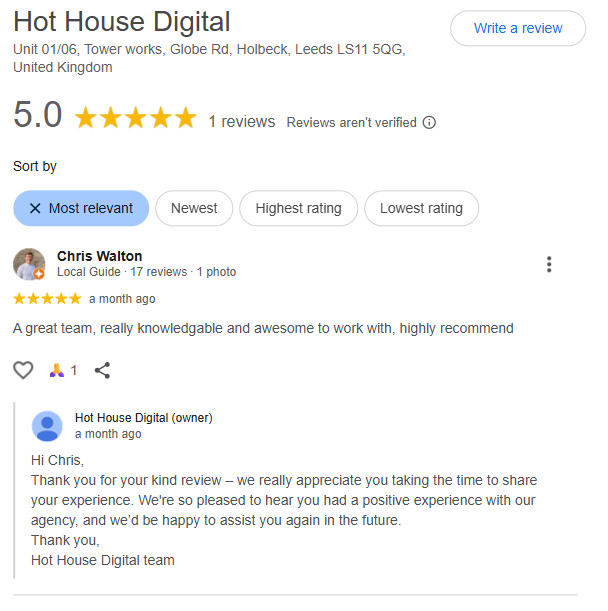
Hot House Hot tip: Use Google’s new review QR codes. You can place them on receipts, at checkout, or in follow-up messages to make reviewing easier.
This is how we got this one…
Star ratings vs. net promoter score (NPS)
Most of us know about star ratings, but NPS provides deeper insight into customer loyalty.
NPS is based on one question:
“How likely are you to recommend our company to a friend or colleague?”
Customers score you from 0 to 10 and fall into these groups:
- Promoters (9 to 10): Loyal fans who recommend you.
- Passives (7 to 8): Neutral; not likely to promote.
- Detractors (0 to 6): Unhappy and likely to spread negative word-of-mouth.
NPS = % of Promoters minus % of Detractors
An NPS above 71 is excellent. Lower than that? It might be time to re-evaluate customer feedback and refine your service.
Crucially, proactively managing your reputation increases NPS. Asking for reviews shows you care. But don’t stop there. Analyse feedback, fix issues, and turn Passives into Promoters.
Does responding to reviews matter?
In short: yes, absolutely.
- 82% of customers prefer businesses that respond to feedback.
- 73% would give a business a second chance if their complaint is addressed.
- 54% may update a negative review if the issue is resolved.
Responding to reviews, both good and bad, shows that you value customers. Handled well, even negative reviews can become an opportunity to rebuild trust and loyalty.
Do reviews impact local SEO?
Google uses three key factors to rank local search results:
- Relevance: Does your business match what the searcher is looking for?
- Distance: How close is your business to the searcher?
- Prominence: How well-known is your business, both online and offline?
Reviews affect Prominence. Google has confirmed that review count and rating influence local search rankings.
For example, if someone in Leeds searches for a dog-friendly Italian restaurant with outdoor seating, Google will rank businesses based on relevance, distance, and how well-reviewed they are.
The takeaway? Good reviews help you rank better locally.
Still with us? Great. Here’s a quick recap…
- Customer reviews matter. They impact visibility, trust, and SEO.
- Diversify your strategy. Use both first- and third-party reviews.
- Be proactive. Ask for reviews, follow up via SMS and email, and respond thoughtfully.
- Monitor your NPS. It reveals how loyal your customers really are.
- Respond to all reviews. It shows you care and can turn negatives into positives.
And yes, reviews do influence your Google local search rankings.
Want to get more from your reviews and show up more often in local search? Let’s have a chat and see how we can help you make that happen.


