
You’ve got the insights. You’ve pulled the best ideas out of your engineers, developers, or researchers, and you’ve done it in a way that didn’t make them hate you.
Great, now what?
Now, it’s time to turn that raw input into SEO-friendly content that resonates with your audience and of course, ranks well too. Having the right information is good, but annoyingly, not good enough unless it’s structured and optimised.
Here’s how you do it…
1. Structuring expert content for maximum impact
The biggest mistake STEM brands make is putting a load of text onto the page and just hoping the words alone will cut it. Sorry to go all ‘bubble-burst’ on you here, but even if the insights are brilliant, nobody’s going to read it if it’s not digestible.
How to structure expert content:
- Tell a story – Frame technical information within a relatable context.
- Break it down – Use clear headings and subheadings to guide the reader through the piece.
- Lead with the takeaway – Start each section with the key insight, then dive into the details.
- Make it skimmable – Use bullet points, numbered lists, and short paragraphs.
- Include expert quotes – They add credibility and make the content more engaging.
Now let’s see that in action…
2. Hooking your reader with a good old ‘scene setter’
One of the biggest challenges with STEM content is making it engaging without losing depth. Your audience is smart and they’ll spot generic content a mile off. But hit them with a wall of jargon, and they’ll switch off just as quickly. They’re human too, remember.
One of the best ways we’ve found to make technical content more engaging is through scene-setting. Instead of launching straight into a dense explanation, start with a relatable story that gently leads into your main point.
For example, check out Aevi’s scene-setting sensation…
Aevi provides payment ecosystem solutions, and in their article on forever payment systems, rather than diving straight into technical jargon, they use scene-setting to make the message resonate. Look here:
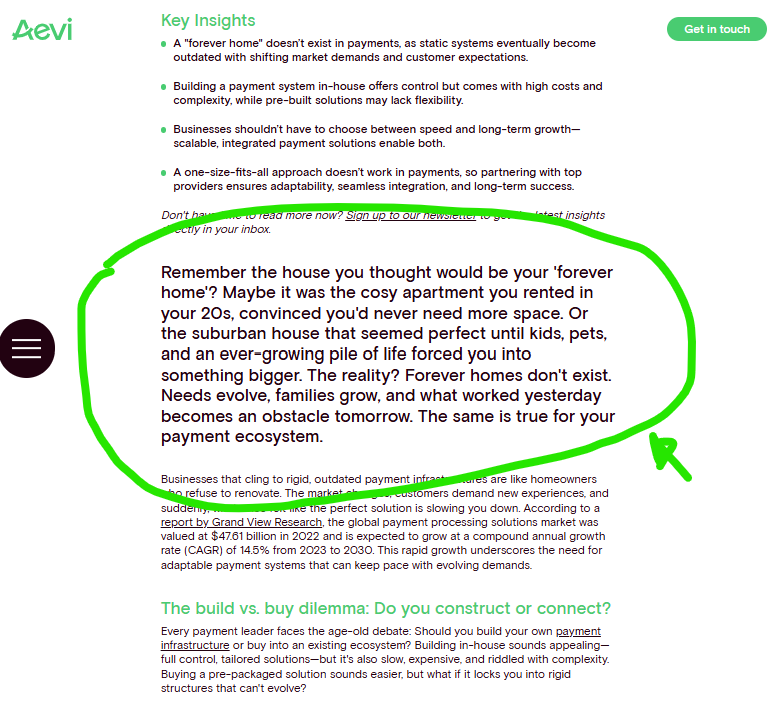
By using a familiar, everyday scenario – outgrowing your “forever home” – Aevi makes the point about evolving payment systems feel intuitive rather than abstract. It’s an effective way to hook the reader and make a technical concept instantly relatable.
How to use scene-setting in your STEM content:
- Start with a story – Think of an everyday scenario that mirrors your technical point.
- Transition smoothly – Link the story to your main insight without over-explaining.
- Keep it short – A few lines are enough to make the connection. You can also close the article with a little nod back to the scene as well – this is a nice touch.
Optimising expert content for SEO
You’ve already cracked the hardest part: gathering accurate, expert-led insights. Now, let’s make sure that content ranks well and gets seen.
Keyword placement without losing the human touch:
- Use keywords naturally – Don’t cram them into every sentence.
- Focus on synonyms and related terms – This makes the content feel organic while boosting SEO.
- Place keywords strategically:
- Title: Should include the primary keyword.
- Headings: Sprinkle in secondary keywords.
- Intro and conclusion: Mention the primary keyword naturally.
- Alt text and image captions: Use variations of the keyword.
Good example vs. keyword stuffing:
Bad:
Our structural integrity testing process is the best for structural integrity testing because it ensures structural integrity in all environments.
Better:
Ensuring structural integrity in challenging environments requires a specialised approach. Our testing methods focus on accuracy and long-term durability, particularly when working with composite materials.
Hot House Hot Tip… if you think you’re fooling Google by sneaking in those keywords willy-nilly, you’re really not… Google’s spiders are set up to seek out keyword-stuffed content, so always avoid it.
Implementing schema markup:
Using schema markup helps search engines understand your content and increases the chances of your brand appearing as featured snippets in the SERPS. For STEM content, it’s especially valuable because it helps Google interpret complex, technical information and present it in a more engaging way.
Why expert-driven content wins
When your content is backed by real-world expertise, it’s not just…better. it’s more findable, shareable, and it’s more trustworthy. Google rewards content that’s authoritative and grounded in experience, and that’s what makes expert-led content so powerful. It performs well in search and promotes long-term credibility.
This is exactly why Google’s EEAT principles matter so much for STEM content. Content that’s informed by genuine expertise and experience is naturally more credible, which is exactly what search engines are looking to surface.
But producing great content is only half the battle. Once you’ve turned expert insights into engaging, SEO-friendly copy, you need to make sure it reaches the right audience and then measure how well it’s performing.


