
If you’re a marketing lead, then you’ve probably had the potentially tricky job of communicating SEO results to C-suite execs.
That’s because SEO performance is rarely one number; it’s a tangle of rankings, traffic, conversions, assisted revenue and more, and it’s not always obvious which one to focus on.
AI has made that picture even more complicated. (“What are we doing about getting found in ChatGPT?” ) Traffic is coming from more places, new metrics like citations are appearing and no one seems to know what’s good and what’s good enough.
So, all of this landing in front of C‑suite execs who are busy, time‑poor, and juggling a long list of competing priorities….well, expect to be met with: “That’s great, but what’s the most important thing we all need to know, here?”.
Let’s fix that.
This guide is about helping you cut through that complexity and present SEO in the language that matters most in the boardroom: clear commercial impact, and a simple story about how you’re helping the business stay ahead of its competitors.
Start with the question they’re actually asking
Before we get into the weeds here, let’s just address the elephant (or is that the croc?) in the room…
Thanks to AI-search, SEO has taken a bit of a hit lately, so let’s just unpack that for a moment.
“If people are getting the answers they need without clicking through to our site, why should we still invest in SEO?”
It’s a fair question. AI search and zero‑click results are pulling more and more answers into the results page. Impressions go up. Clicks don’t always follow. The infamous “crocodile jaws” chart (visibility line rising, click line flattening) is showing up in more company’s dashboards than ever.
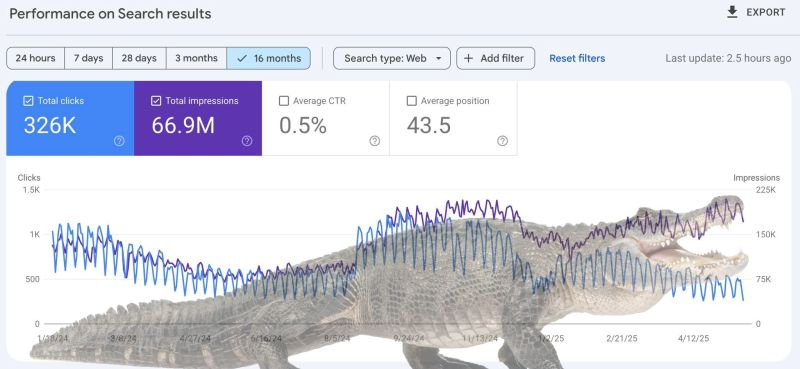
Image credit: Accuracast
But the mistake here, (and what often many C-Suite execs might do) is treat that like SEO has stopped working, when really what’s happening is this:
- The environment has changed.
- The foundations haven’t.
And this is where your comms to C-Suite matters, and what you can say in response…
AI search still has to get its information from somewhere. The same basic SEO principles that used to win you traffic are now what decide whether AI mentions you at all. If you’re not crawlable, understandable and credible, you risk disappearing from those answers entirely.
At the same time, most of your site traffic is still coming from search, and in many cases, from organic search in particular. So investing in SEO is how you protect and grow the channel that already brings in most of your visitors.
That’s the line your C‑suite needs to hear.
Right, so let’s get back to the good stuff…
Let’s assume you’ve had the conversation about AI search and the board is still on board with SEO. Now it’s time to show them the good stuff in a language they understand.
And the main thing to remember here is simple: keep it simple. C‑suite execs are busy people. They don’t need a masterclass in technical SEO, they just need confidence that the channel is working and that you understand what’s driving performance.
Aim for 3-5 slides. If you only get one slide, even better, that just forces clarity.
A simple structure looks like this:
If you have one slide:
Cover the headline business impact, the most important competitive movement, and the single next step or decision needed.
If you have three slides:
Slide 1: What SEO did for the business
- Revenue influenced or pipeline generated
- Leads or conversions from organic
- Cost efficiency vs channels they already know, such as paid search
Slide 2: Where we stand vs the competition
- Headline traffic numbers
- Year‑on‑year and month‑on‑month movement
- A few SEO ranking headlines
- Performance in one or two key categories that matter most to the business
Slide 3: What happens next
- The one or two decisions you need from them
- The investment or backing required
- The risk of doing nothing, in plain language
If you have five slides:
Only use the extra space to add context. For example, one slide on the role SEO now plays in AI visibility, and one slide with a little more proof behind the headline numbers.
Everything else goes in the appendix. Technical wins, content performance, link profiles, crawl stats; have them ready for questions, but don’t lead with them. If the C‑suite want more detail, they’ll ask.
To help, here are some practical ways to talk about the results in a way that they’ll care about…
- “Organic sessions are up 28%” becomes
“Organic search generated 480 more qualified visits to our pricing and enquiry pages, resulting in 63 additional leads this quarter.” - “We’re ranking top three for [keyword]” becomes
“Our [category] page is now ranking more strongly for the terms that matter most in this area, helping us compete more directly with [Competitor A].” - “We improved Core Web Vitals” becomes
“We’ve reduced friction on critical product pages, making it less likely visitors drop out before they can contact sales.”
If you can attach a revenue proxy (even a conservative one) do it. C‑suite execs are used to assumptions and ranges. Be explicit about how you’ve calculated value: “Here’s the logic. Here’s the number. Here’s the direction of travel.”
Here’s one they’ll like…“SEO is the least biased channel of them all”…
This is a point leaders can really use.
Most marketing channels are shaped by budget. Whoever pays more, appears more. SEO is different. Search engines (and now AI answer engines) are trying to rank and recommend based on usefulness, relevance and user experience.
Put simply:
- Paid is “who can shout loudest.” (and, there will always be people with bigger budgets that translate into bigger megaphones)
- SEO is “who can explain best.”
This is where EEAT comes in. When search engines decide which sites to trust, they are looking for:
- Experience – is there clear real‑world knowledge behind this, the kind that shows up in examples, case studies and specifics?
- Expertise – are subject‑matter experts clearly involved in creating or reviewing content, especially in technical or safety‑critical STEM topics?
- Authoritativeness – do other credible sites cite, link to, or reference your work?
- Trustworthiness – is the site technically sound, transparent about who’s behind it, and clear about sources, data and limitations?
For brands, that’s a gift. Your product specialists are already experts. SEO gives you a way to package that expertise into useful, helpful content so that both humans and algorithms can recognise it.
That’s your line back to the “why invest?” question:
“If we want AI systems and search engines to recommend us, we have to be the best answer – and we have to look like the best answer. SEO is how we prove that, in code, in content and in the overall experience.”
Boom.
Use their favourite enemies and favourite numbers
If there’s one guaranteed way to wake up a boardroom, it’s this:
- Show them the money.
- Show them the rivals.
Before you build the report, work with your internal contact (or agency partner) and ask:
- Which competitors does the C-suite mention the most?
- Which keywords or topics matter politically as well as commercially?
- What specific targets is the business being held to this year?
Then reflect that back:
- A couple of “trophy” keywords they’ll recognise: the ones that signal authority in your niche.
- A simple competitor picture: “us vs them” on the terms that really sting if you’re losing.
In short, you just need to show you’re winning (or at least fighting back) in the places they care about most.
At Hot House, we follow our own advice…
We follow this reporting philosophy ourselves at Hot House.
Our monthly SEO reports give clients a clear, top‑down view of performance for that period: the headline commercial impact first, then the key movements in rankings, traffic and conversions underneath. The most important information is visible at a glance; the more granular story sits just below it for anyone who wants to dig in.
Alongside that, we produce project wrap‑up reports that zoom out over six or twelve months. Those pull together the full story: where we started, what we changed, how the market shifted around us, and what that meant for revenue, leads and competitive position. Clients use those directly with their C‑suite, often with a screenshot or two dropped straight into their board packs.
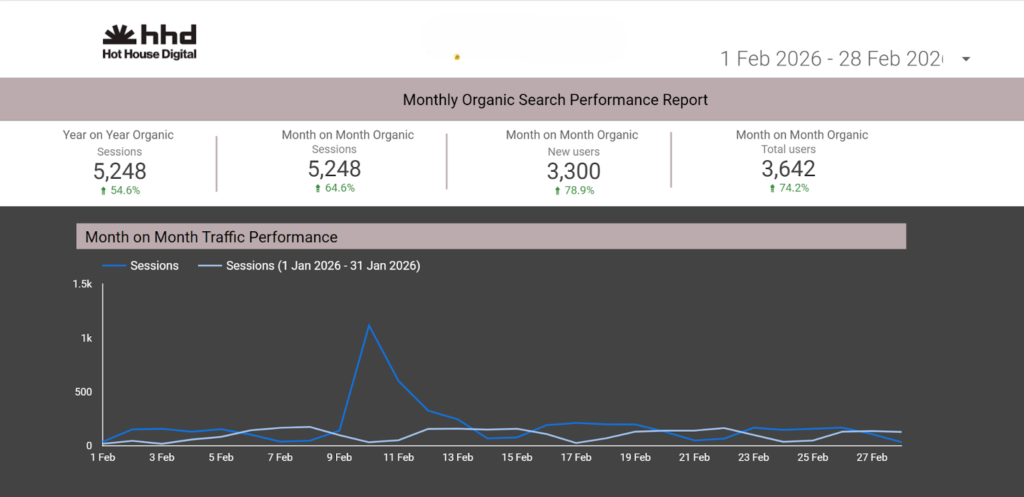
(FYI: This is a real, but anonymised example of a client’s monthly performance report)
Make them (or yourself) look brilliant
Finally, remember who you’re really presenting this report to.
Yes, it’s for the C‑suite. But it’s also for the person who has to stand in front of them with your slides on the screen. If that’s you, then great, this guide will help. But, if you’re preparing this report for someone else, here’s what you need to remember…
Your job is to:
- Make them look strategic
- Give them clean, confident storylines they can own
- Arm them with backup detail so they feel safe taking questions
That means involving them early. Before you send anything, sense‑check:
- “What do you want to come out of this meeting with?”
- “What do you think the board want to see from SEO right now?”
- “Which bits of this story will land best with this particular group of people?”
- “What does this board actually care about most right now?”
- “Which numbers or themes are most likely to matter to the people in the room?”
- “Are there different priorities across different board members that we need to balance?”
The result is a tight, three‑slide narrative that:
- Answers the AI‑era elephant in the room
- Shows SEO as an evidence‑driven, user‑first channel, (opposed to that “dark art” so many still believe it to be)
- Proves its value in numbers the C‑suite already lives by
And crucially, it keeps everyone awake.
Need a hand communicating SEO results to your C-Suite?
If you’re still wrestling with how to get SEO taken seriously in the boardroom, or you just want a second pair of eyes on how you’re currently reporting it, get in touch. We work with STEM brands every day on exactly this. Let’s have a proper chat about what’ll actually land in your business.


